
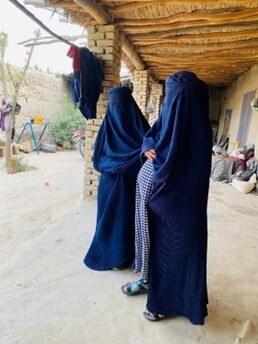
In the heart of a remote village called Joi Jadid lives a woman named Haritha, a mother of four children whose experiences with childbirth are both painful and hopeful. Her story is one that thousands of other women can relate to.
Harirtha explains, “When I was pregnant with my first three children, I either gave birth at home or had to walk to the health center. My husband was always busy working in Heyratan, a town on the border with Uzbekistan, and it was not possible for me to travel with other men. Cars would not take women alone either.”
Because of these difficulties, Haritha lost her first child at home, a painful experience she will never forget.
After that, whenever she reached the ninth month of pregnancy, she would walk to the health center filled with fear and stress. The journey took two days. She would walk part of the way and stay at a relative’s house for one night, then continue again the next morning. When she finally reached the health center, she stayed with relatives until her labour pains began, and only then would she go to the clinic.
This journey brought great hardship, stress, and worry.
Everything changed when an ambulance service arrived in the village. For women like Haritha, it was not only a means of transportation but also a source of safety, peace, and hope.
Haritha recalls, “This time, when I reached the ninth month, I was calm. I knew that if the pain started, I only had to call the ambulance. This gave me peace of mind while waiting for the birth.”
When her labour pains began, Haritha was able to go to the health center using the project ambulance. There was no longer fear of travelling alone, and no one questioned her journey. Because it was a clinic vehicle, both the community and her family felt reassured.
Smiling, Haritha says, “This time I gave birth safely, and for the first time I was not afraid of death.”
For Haritha and many other women in Kaldar, the ambulance represents far more than transportation.
“It is not just a vehicle,” she says. “It is a life saver.”


